Fixr (January 2025) says “extending a concrete driveway costs the same as creating a new driveway, between $8 and $12 square foot,” because the new section still needs excavating, grading and a new sub-base before it’s paved. At that rate, widening a 24-foot-long driveway by 10 feet (240 square feet) comes to about $1,920 to $2,880 (our arithmetic). HomeGuide (June 2025) prices standard plain gray concrete driveways at $6 to $10 per square foot, which would put the same 240 square feet at $1,440 to $2,400. Add-ons that can change the total: a wider apron at the street, a permit, and any work to make the old and new concrete match.
Price per square foot, by source
| Source (date) | Price | What it covers |
|---|---|---|
| Fixr (Jan 2025) | $8–$12 per sq ft | a driveway extension; “subject to the same costs and timelines as a regular driveway” |
| HomeGuide (Jun 2025) | $6–$10 per sq ft | a new standard concrete driveway, installed |
| HomeAdvisor (Jun 2026) | $8–$20 per sq ft | a new concrete driveway, by size |
| Concrete Network extension guide (no date shown) | $4.25–$6.25 per sq ft | “Generally, concrete costs anywhere from $4.25 to $6.25 per square foot”; the page doesn’t say what’s included |
HomeGuide also notes that larger driveways “often have a lower price per square foot due to economies of scale,” so a small add-on may land at the upper end of a range. Fixr’s extension figure assumes ground that still needs work; if you’re paving over existing gravel, Fixr says costs on a new driveway start lower, at $4 per square foot.
Common extensions, worked out
Our arithmetic, at Fixr’s $8–$12 per square foot, 4 inches thick:
| Project | Area | Concrete at 4 inches | Price at $8–$12 per sq ft |
|---|---|---|---|
| Widen a 16 x 40 ft driveway to 20 ft | 4 x 40 ft = 160 sq ft | about 2.0 cubic yards | $1,280–$1,920 |
| Widen a 24 ft-long driveway by 10 ft | 10 x 24 ft = 240 sq ft | about 3.0 cubic yards | $1,920–$2,880 |
| Add a 10 x 20 ft parking pad | 200 sq ft | about 2.5 cubic yards | $1,600–$2,400 |
Concrete Network gives 16 by 40 feet as the average U.S. two-car driveway and says a two-car driveway “should have a minimum width of 20 feet to allow enough room for car doors to open,” with 24 feet better if space allows. It also suggests ordering 10% to 15% more concrete than the computed volume. For a 10 x 20 ft pad, HomeGuide’s size table gives $1,200 to $3,000 for a standard to basic driveway of that size. Try your own measurements in the concrete cost calculator.
How the new section joins the old one
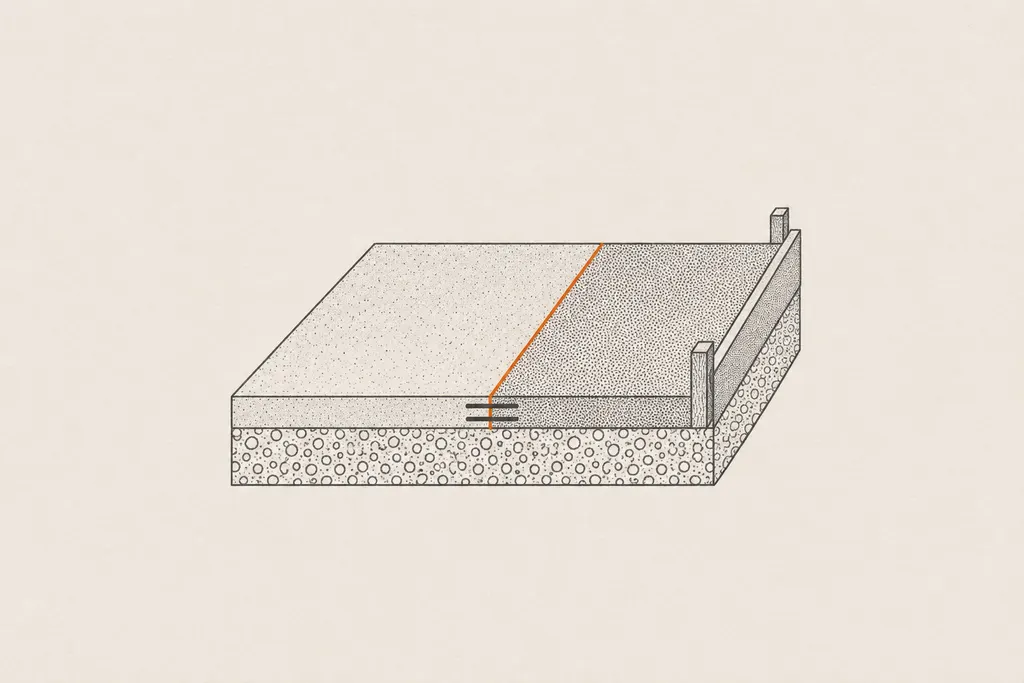
Where new concrete meets old, the contractor has to decide whether the two pieces move separately or are tied together. The National Ready Mixed Concrete Association’s CIP 6 describes the options:
- Isolation (expansion) joints let slabs move independently and belong “at junctions of driveways with walks, curbs or other obstructions.”
- Construction joints are “surfaces where two successive placements of concrete meet.” CIP 6 says “it may be desirable to achieve bond and continue reinforcement through a construction joint,” and that “metal dowels should be used in slabs that will carry heavy loads,” carefully lined up and parallel.
Industry guidelines from the Illinois Ready Mixed Concrete Association (a state group whose driveway guidelines cite Michigan specifications) call for a full-depth isolation joint where new concrete abuts existing structures such as garage floors. Some cities write a joint into their rules: Shaker Heights, Ohio, requires half-inch expansion joints where concrete abuts other concrete, including adjacent drives, and where a 4-inch drive meets a 6-inch apron. Ask the contractor which joint goes at the seam and to put it in the proposal. Concrete Network also recommends asking for “a jointing plan as part of his written proposal.”
The new section needs the same basics as any concrete driveway, per Concrete Network’s construction checklist:
- at least 4 inches thick; local soil and weather “may also require a thicker driveway slab” (see how thick should a concrete driveway be); ask how thick the old slab is;
- a subgrade that is uniform in soil and compaction, with soft spots dug out and replaced with gravel or crushed rock;
- a slope away from the house of at least 1/8 inch per foot, the figure Concrete Network attributes to the Portland Cement Association.
Will it match? Concrete Network says that if you pour the new concrete and stop there, “the difference between the old and new parts will probably be noticeable.” Its options include staining the whole driveway so old and new match. Its replacement guide adds that color matching new concrete to existing “can be a challenge.” If the old driveway is near the end of its life anyway, compare the price of a full concrete driveway replacement.
Permits, width limits and the apron
Concrete Network says whether you need permission “depends on the scope of your project,” and that some cities require you to keep a certain percentage of landscaped area in the front-yard setback. Two examples of how specific the rules get:
- Wentzville, Missouri: “A permit is required for driveway additions and replacements when the proposed driveway is touching both the City street curb and the house foundation.” The fee is the estimated construction cost × 0.0050 (minimum $35) plus a $50 plan review, with a form inspection and a final inspection.
- Shaker Heights, Ohio: pre-pour inspections are required before new concrete is installed.
If the widening reaches the street, the apron and curb cut change too. Fixr prices a concrete apron at $1,536 to $4,320, and HomeAdvisor at $1,530 to $4,320. HomeGuide says permits for driveway installations cost $50 to $200. Check your city’s building or planning department and your HOA before you sign. Call 811 a few business days before digging so buried utility lines get marked.
Questions to ask before you sign
- What’s the price per square foot, and does it include excavation, grading and new base?
- What joint goes between old and new concrete: isolation, or doweled construction joint?
- Will the new section match the old thickness and slope?
- How different will the color be, and what does it cost to stain the whole driveway?
- Does the job touch the curb, apron or sidewalk, and who gets the permit?
For prices on a full new driveway by size and finish, see concrete driveway cost.
Have your own measurements? Run the concrete cost calculator — cubic yards, bags and a sourced price range for your size.
Illustrations here are AI-made sketches that show the idea. They are not photos of a real slab, driveway, product, job or person.
Sources
- Fixr — How much does it cost to pour a concrete driveway? (updated Jan 31, 2025)
- HomeGuide — How Much Does a Concrete Driveway Cost? (June 3, 2025)
- HomeAdvisor — How Much Does a Concrete Driveway Cost in 2026? (updated Jun 20, 2026)
- Concrete Network — Concrete Driveway Extension Ideas: How to Widen a Driveway (no update date shown; checked Nov 2, 2026)
- Concrete Network — What's the Average Cost of a Concrete Driveway? (updated Jan 13, 2026)
- Concrete Network — How Much Concrete Do You Need for a Driveway? (no update date shown; checked Nov 2, 2026)
- Concrete Network — 8 Concrete Driveway Construction Essentials (updated Mar 12, 2026)
- Concrete Network — 7 Signs You Need Driveway Replacement (published Jan 23, 2024)
- National Ready Mixed Concrete Association — CIP 6, Joints in Concrete Slabs on Grade (1979, 1989 and 1998; copy hosted by Prairie Material), p. 1–2
- Illinois Ready Mixed Concrete Association (state industry group; its driveway guidelines cite Michigan specifications) — Driveways, homeowner guidelines (used by permission of NRMCA; no update date shown; checked Nov 2, 2026)
- City of Shaker Heights, Ohio — Residential Asphalt & Concrete Driveway Installation Requirements (effective Jun 6, 2019)
- City of Wentzville, Missouri — Residential Driveway Guide (revised May 3, 2024)
- Call 811 (Common Ground Alliance) — 811 Before You Dig (checked Nov 2, 2026)
Updated November 2, 2026
Before you build
Call 811 a few business days before any digging so buried utility lines get marked. Driveway aprons, foundations and taller retaining walls may need a permit — ask your local building department. Wet concrete can burn skin: crews wear gloves, boots and eye protection. Get the price, thickness, base and reinforcement in a written contract with a contractor who carries the license (where your state requires one) and insurance.