Asphalt costs less to put in; concrete costs more but lasts longer. HomeGuide (December 2025) prices an asphalt driveway at $5 to $12 per square foot installed and a concrete driveway at $6 to $15, or $2,000 to $7,200 versus $2,400 to $8,600 for a two-car driveway. It gives asphalt a lifespan of 15 to 30 years and concrete 30 to 40. Asphalt can be driven on within days; concrete needs about a week. Which one fits your house depends mostly on climate, upkeep you’re willing to do, and local rules for the section at the street.
Side by side
| Asphalt | Concrete | |
|---|---|---|
| Installed price per sq ft (HomeGuide, Dec 2025) | $5–$12 | $6–$15 |
| Two-car driveway (HomeGuide) | $2,000–$7,200 | $2,400–$8,600 |
| Lifespan (HomeGuide) | 15–30 years | 30–40 years |
| Before you drive on it (HomeGuide) | cure 24–72 hours | 7–10 days; 30 days for heavier vehicles such as trucks, RVs or boats |
| Sealing (HomeGuide) | reseal every 3–5 years | sealing optional |
| Look | black, few color options | can be colored, stamped or textured |
Higher prices on both sides apply to colored, bordered and stamped finishes, HomeGuide notes.
Other guides’ numbers
Guides price the two materials differently, so each one’s figures are shown with its date rather than averaged.
| Source (date) | Asphalt price | Concrete price | Asphalt life | Concrete life |
|---|---|---|---|---|
| This Old House (Jun 2026, Fixr data) | $7–$15 per sq ft with labor, not counting removal or grading | $3,460–$6,910 per driveway (national average) | 20–30 years | “can last for 50 years with minimal maintenance” |
| Fixr comparison (2021, per page data) | $2–$6 per sq ft installed | $4–$10 per sq ft installed | about 30 years with proper maintenance | “50 years or more” |
| Concrete Network cost guide (Jan 2026) | $3–$6 per sq ft, installation | $5–$8 per sq ft, plain gray | “10 to 15 years before needing replacement” | “can last for decades” |
| Bob Vila (Jun 2024) | $5–$15 per sq ft | $8–$18 per sq ft | 20–30 years | 50 years or more |
Fixr’s own asphalt cost guide (August 2022) explains much of the spread: $2 to $6 per square foot is for paving over an existing driveway, while a new asphalt driveway “fully installed” runs $7 to $15. The same guide says “paving an existing driveway with concrete costs $4 - $10 a square foot,” the concrete figure in Fixr’s comparison. Concrete Network’s older comparison page, with no date shown, gives about $2 to $4 for new asphalt and $5 to $7 for plain concrete. Before comparing two quotes, check that both include the same removal, grading and base work. For concrete prices by size and finish, see concrete driveway cost.
Cure time and upkeep
- Getting the car back. HomeGuide says to let new asphalt cure 24 to 72 hours, and to wait 7 to 10 days before driving on new concrete. This Old House says a concrete driveway needs “at least a week before driving.”
- Sealing asphalt. HomeGuide and This Old House both say to reseal asphalt every three to five years; This Old House puts the average at $420.
- Sealing concrete. Concrete Network says concrete “doesn’t have to be sealed to perform well,” though decorative finishes can benefit from a sealer every few years. This Old House says to reseal it every three to five years at $1 to $2 per square foot (elsewhere on the same page, every two to three years). The guides disagree, so ask your installer what they recommend for your finish.
- Stains and heat. This Old House says asphalt’s dark color hides oil and stains but can soften in extreme heat; concrete’s light surface shows stains more.
Climate: cold winters, hot summers
The guides lean toward asphalt in cold climates. HomeGuide says “asphalt handles freeze-thaw cycles better,” and This Old House says concrete “is prone to cracking during freeze-thaw cycles” and that road salt and deicers can damage its surface. In hot climates it flips: This Old House says asphalt “can soften and degrade in hot climates,” while concrete is “minimally affected by hot weather.”
Concrete is still poured in cold states; the mix is what changes. The Tennessee Concrete Association’s summary of the American Concrete Institute’s residential code (ACI 332-20) says most Tennessee driveways would need the “very severe” freeze-thaw exposure class, which calls for:
- 4,500 psi compressive strength at 28 days;
- a maximum water-cementitious ratio of 0.45;
- air entrainment at 6%, plus or minus 1½%.
The Illinois Ready Mixed Concrete Association, a state industry group whose driveway guidelines cite Michigan specifications and winters (“Michigan is classified as a severe weathering region”), calls for at least 4,000 psi at 28 days “(refer to local code requirements)” and 6.5% ± 1.5% air, and says “Do not apply deicing chemicals for snow and ice removal the first winter.” If you live where it freezes, ask the contractor which mix and air content the quote is based on. This Old House describes a New England replacement where the team chose concrete “for its longevity in harsh winters,” specified at 5,000 psi and six inches thick.
Local rules can make the choice for you
Cities often regulate the part of the driveway that crosses the sidewalk to the street. In Shaker Heights, Ohio, for example, no asphalt paving is permitted for driveway aprons or sidewalk blocks in the public right of way, and “paving over existing concrete with asphalt is prohibited.” The same rules set a concrete driveway at 4 inches minimum and the sidewalk and apron portion at 6 inches. Your city’s rules may differ; ask your local building department and your HOA, if you have one, before you pick a material.
Quick read
- Lower upfront price: asphalt, in most guides above.
- Longer life and more finishes: concrete, in every guide above.
- Freezing winters: asphalt is the cost guides’ default; concrete is poured there too, with a freeze-thaw mix (air-entrained, higher strength) and no deicers the first winter.
- Hot summers: concrete, which This Old House says is “minimally affected by hot weather.”
- Back in use fast: asphalt (days, not a week).
Questions to ask before you sign
- Does the price include removing the old surface, grading and new base, and how thick is each layer?
- For concrete: what thickness, psi, air content and joint spacing? (See how thick should a concrete driveway be.)
- For asphalt: how many inches of asphalt over how many inches of base, and when is the first sealcoat? HomeGuide (May 2025) says a residential asphalt driveway should include “6 to 8 inches of compacted gravel base and 2 to 3 inches of compacted asphalt surface.”
- What does the city require for the apron, and who pulls the permit?
If you’re replacing an old driveway, the tear-out is priced on concrete driveway replacement cost. To price a concrete driveway for your own size, use the concrete cost calculator.
Have your own measurements? Run the concrete cost calculator — cubic yards, bags and a sourced price range for your size.
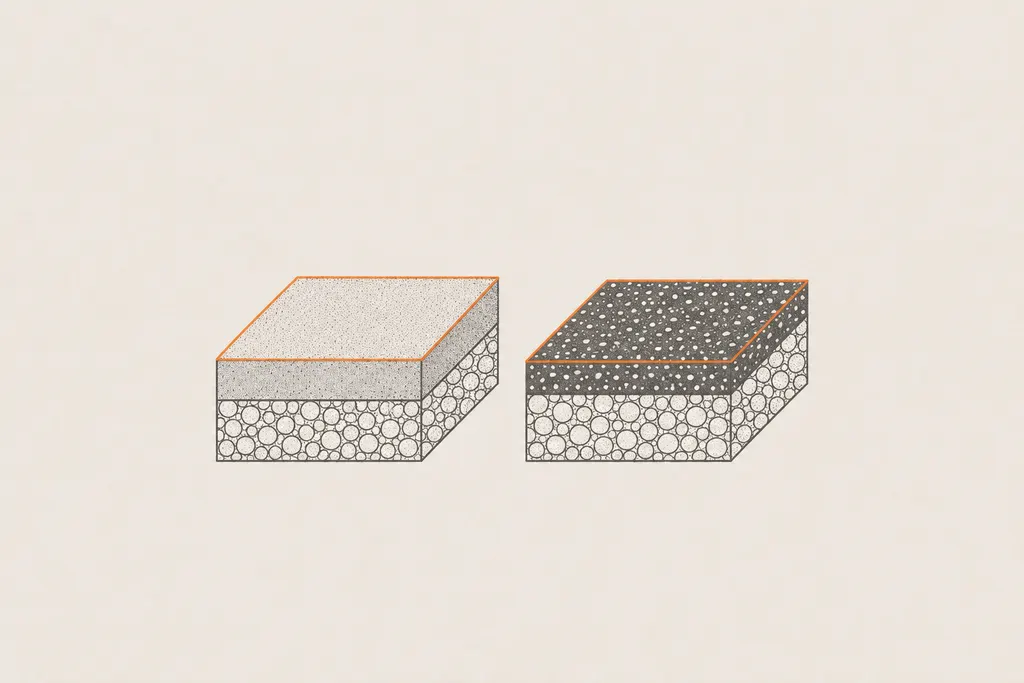
Illustrations here are AI-made sketches that show the idea. They are not photos of a real slab, driveway, product, job or person.
Sources
- HomeGuide — How Much Does an Asphalt Driveway Cost vs. Concrete? (December 19, 2025)
- HomeGuide — How Much Does Paving an Asphalt Driveway Cost? (May 28, 2025)
- This Old House — Asphalt vs. Concrete: A Comparative Guide (updated Jun 10, 2026; cost data via Fixr)
- Fixr — Asphalt vs Concrete Driveway (no date shown on the page; page data says modified May 27, 2021; checked Nov 2, 2026)
- Fixr — How much does it cost to build an asphalt driveway? (updated Aug 19, 2022)
- Concrete Network — What's the Average Cost of a Concrete Driveway? (updated Jan 13, 2026)
- Concrete Network — Asphalt vs. Concrete Driveway (no update date shown; checked Nov 2, 2026)
- Bob Vila — The Cost of Asphalt vs. Concrete Driveway Cost (updated Jun 26, 2024)
- Tennessee Concrete Association — Concrete Driveways in Tennessee: ACI 332-20 highlights (no date shown; checked Nov 2, 2026), p. 1
- Illinois Ready Mixed Concrete Association (state industry group; its driveway guidelines cite Michigan specifications) — Driveways, homeowner guidelines (used by permission of NRMCA; no update date shown; checked Nov 2, 2026)
- City of Shaker Heights, Ohio — Residential Asphalt & Concrete Driveway Installation Requirements (effective Jun 6, 2019)
Updated November 2, 2026
Before you build
Call 811 a few business days before any digging so buried utility lines get marked. Driveway aprons, foundations and taller retaining walls may need a permit — ask your local building department. Wet concrete can burn skin: crews wear gloves, boots and eye protection. Get the price, thickness, base and reinforcement in a written contract with a contractor who carries the license (where your state requires one) and insurance.