A stamped concrete patio costs $8 to $19 per square foot installed, according to HomeGuide’s stamped concrete guide (December 2025), so a 20×20 patio comes to $3,200 to $7,600. HomeGuide’s range is for “basic to average coloring and design complexity” on a 4″ to 6″ slab, and it leaves out excavation, ground prep and tearing out an old patio. Other guides run wider: Concrete Network starts basic stamped work at $10 to $14 per square foot, Bob Vila (2024) gives $8 to $28 “depending on the pattern,” and Fixr (2022) gives $15 to $30.
Stamped concrete patio cost by size
Both columns come from HomeGuide, but from two different guides, so the dates differ. HomeGuide’s stamped figures exclude excavation and prep; neither column includes tearing out an old patio.
| Patio size | Square feet | Stamped (HomeGuide stamped guide, Dec 2025) | Plain concrete (HomeGuide patio guide, Jul 2025) |
|---|---|---|---|
| 10×10 | 100 | $800 – $1,900 | $400 – $1,200 |
| 12×12 | 144 | $1,150 – $2,750 | $600 – $1,700 |
| 10×20 | 200 | $1,600 – $3,800 | $800 – $2,400 |
| 16×16 | 256 | $2,000 – $4,850 | $1,000 – $3,100 |
| 20×20 | 400 | $3,200 – $7,600 | $1,600 – $4,800 |
| 25×30 | 750 | $6,000 – $14,250 | $3,000 – $9,000 |
A 20×20 patio at 4 inches takes about 4.94 cubic yards of concrete (400 × 4 ÷ 12 ÷ 27). Stamping doesn’t change the yardage; it changes the labor and materials laid on top. Our concrete cost calculator does the yardage for your own size.
Price by design level
HomeGuide says “Prices increase for every extra color and pattern added to the concrete.” Three guides tier the price that way, with different numbers:
| Design level | HomeGuide (Dec 2025) | Concrete Network (Jan 2026) | Bob Vila (Apr 2024) |
|---|---|---|---|
| Basic: one pattern, one color, no border | $8 – $13 | $10 – $14 | $8 – $12 |
| Mid-range: two or more colors, border, contrasting pattern | $13 – $19 | $14 – $20 | $12 – $18 |
| High-end: several patterns and colors, hand-detailed work | $19 – $26+ | $20+ | $18 – $28 |
The tier descriptions are HomeGuide’s and Concrete Network’s; Bob Vila’s tier paragraph doesn’t say what each includes. In its color section, Bob Vila gives “A basic stamp in a single color” at $10 to $15 per square foot and “A simple two-tone pattern with a border” at $12 to $18.
Concrete Network suggests ways to keep the price down: stamp only a border and leave the open center area plain, keep to one color, or use seamless skins, which “are easier and faster to use, therefore reducing your costs.”
Stamped vs. exposed aggregate vs. colored concrete
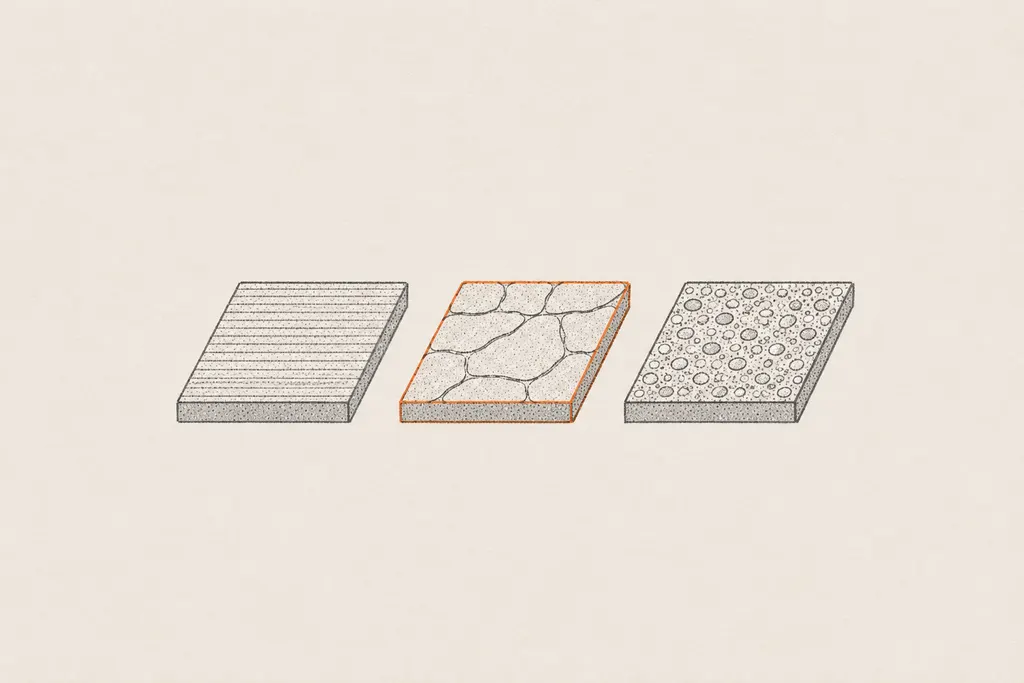
HomeGuide’s patio guide prices each finish on a new patio; Fixr and This Old House give their own figures for some of them.
| Finish (new patio, installed) | HomeGuide (Jul 2025) | Fixr (Aug 2022) | This Old House (Jun 2026) |
|---|---|---|---|
| Plain / smooth | $4 – $12 per sq ft | $6 – $17 | $2 – $15 |
| Broom finish | $6 – $13 | — | — |
| Exposed aggregate | $7 – $18 | — | — |
| Stained | $8 – $25 | — | $5 – $10 |
| Stamped | $9 – $30 | $15 – $30 | $5 – $15 |
HomeGuide’s patio guide range for stamped ($9 to $30) is wider than its newer stamped guide ($8 to $19); both are shown because they are separate pages. None of these guides gives a separate price for integrally colored concrete; the “Stained” row is color applied to the surface.
Exposed aggregate. HomeGuide describes it as decorative stones in the concrete revealed “by removing the top cement layer.” Concrete Network lists three ways to get the stone to the surface: seeding it onto the fresh slab, having the ready-mix plant put it in the mix, or a 1- to 2-inch topping layer over a regular slab. It also notes that “few additional materials (other than the decorative aggregate)” are needed, and Concrete Network’s stamped cost page adds that exposed aggregate “may save a little bit of money in comparison to a stamped surface.”
Colored concrete. HomeGuide says color “can be added through integral color in the concrete mix, surface hardeners, or staining after installation.” Concrete Network adds that integral color and color hardener only work on new concrete: “With the exception of integral color and hardener, all of these products can be used on new or existing concrete.” On stamped work, Concrete Network says contractors “broadcast color hardener over the surface and apply a release agent to the stamps so they won’t stick.”
What the stamping premium pays for
HomeGuide breaks its $8 to $19 down as concrete materials $2 to $6, labor $3 to $9, and stamping and coloring $3 to $4 per square foot. Its regular 10×20 patio costs $800 to $2,400 against $1,600 to $3,800 stamped.
Not in that price, per the same HomeGuide guide:
- Old concrete removal: $3 to $8 per square foot (see cost to replace a concrete patio).
- Grading the yard: $0.40 to $2.00 per square foot.
- Concrete sealing: $1 to $3 per square foot.
HomeGuide also lists a permit at $50 to $350 on average; ask whether it’s in the quote.
Ask how joints will be handled. Concrete Network says joints “must be cut to a depth of at least one-quarter the slab thickness,” and suggests asking the contractor to hide them “by integrating them into the pattern lines wherever possible.”
Upkeep that belongs in the budget
- Resealing. HomeGuide and Concrete Network both say stamped concrete should be resealed every 2 to 3 years; Concrete Network adds “depending on your weather conditions.” HomeGuide notes it is “low maintenance when sealed.”
- Cold climates. HomeGuide lists “Cracks with freeze / thaw cycles & deicing salts” among the downsides. Concrete Network advises avoiding deicing salts, “especially during the first winter after the pavement is installed.”
- Traction. On driveways, HomeGuide says to choose a finish that won’t leave “a smooth surface that gets dangerously slippery in the rain.”
- Lifespan. HomeGuide: “Stamped concrete lasts 25 to 50 years,” longer where the ground doesn’t freeze.
Concrete Network’s patio guide says plain concrete costs less than pavers, but “as you add upgrades, like stamping and coloring, the prices become more comparable”; see pavers vs. a concrete patio. For a stamped driveway, HomeGuide gives $6,900 to $10,400 for a 24×24 two-car size; more in concrete driveway cost.
Questions to ask before you sign
- Which pattern and how many colors are in this price? Is the border included?
- Is the color integral, a color hardener, or a stain?
- What thickness, and what base and reinforcement go under it?
- Where will control joints go, and can they follow the pattern lines?
- Which sealer is included, and what does resealing cost later?
- Are removal of the old slab, grading and the permit in this quote or separate?
- Can I see stamped work you’ve done that’s at least a few winters old?
To compare a plain slab with stamped and exposed-aggregate finishes for your patio size, use the concrete cost calculator.
Have your own measurements? Run the concrete cost calculator — cubic yards, bags and a sourced price range for your size.
Illustrations here are AI-made sketches that show the idea. They are not photos of a real slab, driveway, product, job or person.
Sources
- HomeGuide — How Much Does Stamped Concrete Cost? (2026) (written by Sarah Noel, dated Dec 23, 2025)
- HomeGuide — How Much Does a Concrete Patio Cost? (2026) (written by Kristen Cramer, dated July 10, 2025)
- Concrete Network — Stamped Concrete Cost (reviewed Jan 26, 2026)
- Concrete Network — Concrete Patio Cost (updated Jan 20, 2026)
- Concrete Network — Stamped Concrete Installation Process (updated June 9, 2021)
- Concrete Network — How to Clean and Maintain Stamped Concrete (updated May 13, 2020)
- Concrete Network — Exposed Aggregate Concrete (updated Apr 22, 2020)
- Concrete Network — Colored Concrete (updated Oct 20, 2020)
- Bob Vila — Here's How Much a Stamped Concrete Patio Costs (updated Apr 26, 2024)
- Fixr — Cost to Build a Patio (updated Aug 19, 2022)
- This Old House — Concrete Patio: A Comprehensive Guide (updated June 8, 2026; cost data from Angi and HomeAdvisor)
Updated November 2, 2026
Before you build
Call 811 a few business days before any digging so buried utility lines get marked. Driveway aprons, foundations and taller retaining walls may need a permit — ask your local building department. Wet concrete can burn skin: crews wear gloves, boots and eye protection. Get the price, thickness, base and reinforcement in a written contract with a contractor who carries the license (where your state requires one) and insurance.