New poured concrete steps cost $200 to $500 per step, or $1,000 to $5,000 for 5 to 10 steps, according to HomeGuide (December 2025). Precast steps, made off-site and set in place, run $100 to $350 per step. HomeAdvisor (updated June 2026) puts “Custom, poured-in-place staircases” at $1,800 to $6,000 and precast at “about $600 to $2,000,” with an average project of $3,500. If old steps have to come out first, add removal: $250 to $500 per HomeGuide, $200 to $400 per HomeAdvisor.
Concrete steps cost by number of steps
HomeGuide prices installed steps by count, assuming a 7-inch rise each:
| Steps (total height) | Precast, installed | Poured, installed |
|---|---|---|
| 1 step (7″) | $100–$350 | $200–$500 |
| 3 steps (21″) | $300–$1,100 | $600–$1,500 |
| 5 steps (35″) | $500–$1,800 | $1,000–$2,500 |
| 10 steps (70″) | $1,000–$3,500 | $2,000–$5,000 |
| 15 steps (105″) | $1,500–$5,300 | $3,000–$7,500 |
HomeGuide’s prices include a “landing platform when necessary.” HomeAdvisor prices by width instead, without saying poured or precast:
| Step width | Average cost per step (HomeAdvisor) |
|---|---|
| 3 feet | $150–$450 |
| 4 feet | $200–$600 |
| 5 feet | $250–$750 |
| 6 feet | $300–$900 |
Step 1: count the steps from the total rise
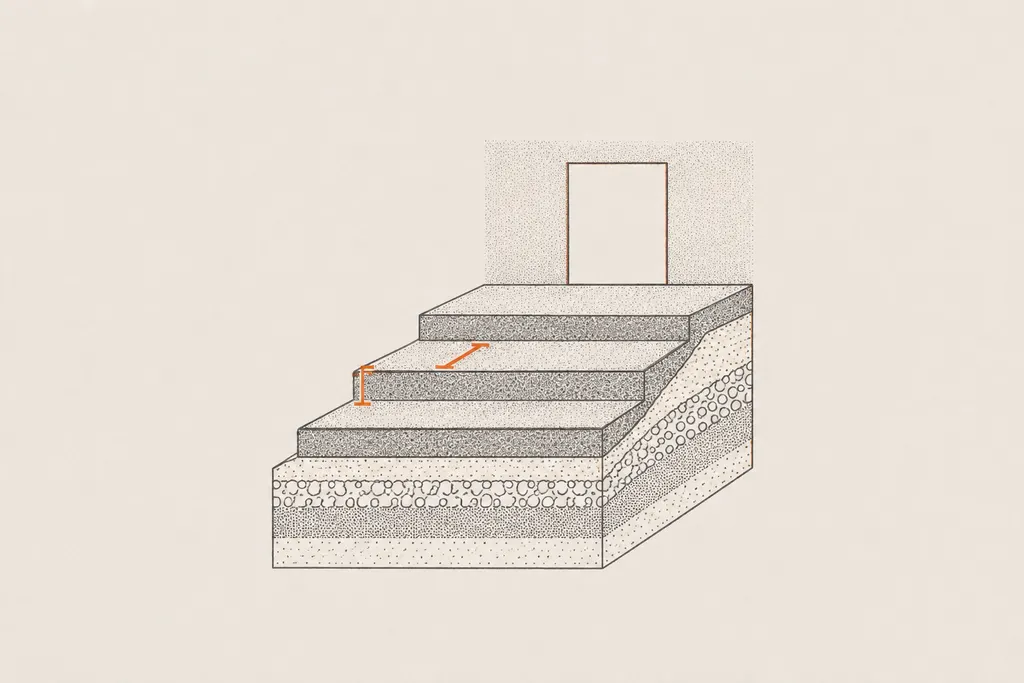
Measure the height from the walk or ground up to the door threshold. HomeGuide’s rule of thumb is “Number of steps = Height (in inches) ÷ 7.” The contractor then works to the building code. In the 2021 International Residential Code (IRC), which many towns adopt with local changes:
- Riser: “The riser height shall be not more than 7¾ inches,” and within one flight the tallest riser may not exceed the shortest “by more than 3/8 inch” (R311.7.5.1).
- Tread: “The tread depth shall be not less than 10 inches” (R311.7.5.2).
- Width: stairways at least 36 inches in clear width above handrail height (R311.7.1).
- Landing at the door: “There shall be a landing or floor on each side of each exterior door,” at least as wide as the door and at least 36 inches deep in the direction of travel (R311.3). At the required exit door, if the door doesn’t swing over it, the outside landing may sit up to 7¾ inches below the threshold (R311.3.1). At other exterior doors, “A top landing is not required where a stairway of not more than two risers is located on the exterior side of the door, provided that the door does not swing over the stairway” (R311.3.2).
- Handrail: required “on not less than one side of each flight of stairs with four or more risers” (R311.7.8).
- Guard: required where a walking surface, including stairs and landings, is “more than 30 inches” above the grade below (R312.1.1).
Example: a 28-inch rise divided by 7 gives 4 risers of 7 inches, which is under the 7¾-inch limit. Four risers means a handrail. At 10 inches per tread, the three treads below the landing need at least 30 inches of run, plus the 36-inch landing at the door. Your local building department has the final word on which code edition applies.
Poured vs. precast: what you’re paying for
HomeGuide describes precast steps as “Premade and delivered, typically 3’ to 5’ wide and up to 6 steps tall,” and poured steps as “Custom poured on site, can be any size or height, higher labor costs.” For 5 to 10 precast steps it breaks the cost into the steps ($200–$1,700), delivery ($200–$1,000) and installation labor ($100–$800). The same page gives the precast total as both $500–$3,000 and $500–$3,500.
For poured steps, HomeGuide says “Framing and rebar or mesh is typically included in material costs.” HomeAdvisor puts labor alone at $600 to $1,600 and notes that poured steps have a “Long curing time,” while precast has “No curing time needed.”
HomeAdvisor also prices precast by construction: “Solid steps cost about $600 each,” while “Hollow precast versions, on the other hand, average $200 per step.”
What raises the price
- Size: more steps or wider steps mean more concrete and labor (HomeAdvisor’s width table above).
- Landing: HomeGuide says “Most steps or stairs over 5 feet tall require a landing platform, which increases costs.” That is HomeGuide’s rule of thumb for an extra landing; the landing at the door is a separate code requirement (see above).
- Railings: HomeGuide gives $20 to $250 per linear foot depending on material; HomeAdvisor lists wood or metal railings at $300 to $600.
- Finish: HomeGuide prices stamped concrete at $8 to $19 per square foot and basic stain at $2 to $5 more per square foot. See stamped concrete cost.
- Coatings and treads: a coating runs $200 to $400 and slip-resistant treads $100 to $500 (HomeGuide).
- Ground prep: grading costs $0.40 to $2.00 per square foot (HomeGuide).
- Permit: HomeGuide says a permit “costs $100 to $1,000 and may be required, depending on the size and local codes.”
- Tie-in to the house: HomeGuide notes that “Some city codes require securing concrete stairs to the foundation wall.” Ask your building department whether yours does.
The concrete itself
Outdoor steps take a stronger mix in colder climates. The 2021 IRC (Table R402.2) sets the minimum strength for “Porches, carport slabs and steps exposed to the weather” at 2,500 psi where weathering potential is negligible, 3,000 psi where it’s moderate and 3,500 psi where it’s severe, and requires air-entrained concrete (5 to 7 percent air) in the moderate and severe cases. The written quote should name the psi and whether the mix is air-entrained.
Replacing old steps: removal comes first
Taking out old steps is its own line. HomeGuide’s removal guide puts it at $250 to $500 “for steps at a home or deck entrance,” depending on whether “a tractor, bobcat, skid steer, or other heavy lifting equipment is necessary.” HomeAdvisor gives $200 to $400 “on top of the cost of installing new steps.”
If the steps lead down to a new walk or patio, it often makes sense to price them together; see concrete sidewalk cost and concrete patio cost.
What should be in the written quote
- Number of steps, rise and tread depth, width, and landing size
- Poured or precast (and solid or hollow, if precast)
- Concrete strength in psi, air entrainment, and reinforcement
- How the steps attach to the house or sit on their own footing
- Railing type and length
- Removal and haul-away of the old steps as a separate line
- Who gets the permit, if one is needed
Questions to ask before you sign
- How many risers will there be, and what height is each one?
- Will there be a landing at the door, and how deep?
- Does the price include the handrail?
- Is the removal of the old steps included, and is disposal part of it?
- How long before we can use the steps?
To estimate the concrete and get a price range for your step count from these sources, use the concrete cost calculator.
Have your own measurements? Run the concrete cost calculator — cubic yards, bags and a sourced price range for your size.
Illustrations here are AI-made sketches that show the idea. They are not photos of a real slab, driveway, product, job or person.
Sources
- HomeGuide — How Much Do Concrete Steps Cost In 2026? (Precast vs. Poured) (Jennifer Carlson, Dec 29, 2025)
- HomeAdvisor — How Much Do Concrete Steps Cost in 2026? (updated Jun 20, 2026)
- HomeGuide — How Much Does Concrete Removal Cost? (2026 Prices) (Sarah Noel, May 27, 2025)
- ICC — 2021 International Residential Code, Chapter 3 (R311.3, R311.7, R312.1)
- ICC — 2021 International Residential Code, Chapter 4 (Table R402.2, concrete strength)
Updated November 2, 2026
Before you build
Call 811 a few business days before any digging so buried utility lines get marked. Driveway aprons, foundations and taller retaining walls may need a permit — ask your local building department. Wet concrete can burn skin: crews wear gloves, boots and eye protection. Get the price, thickness, base and reinforcement in a written contract with a contractor who carries the license (where your state requires one) and insurance.